
A semen analysis can be abnormal. A patient can have azoospermia. Hormonal results can raise new questions. A genetic finding can change the direction of an evaluation.
But the difficult part of male infertility is often not knowing what each finding means.
It is knowing what to do with the findings together.
That is where postgraduate education in male infertility has an opportunity to evolve.
For years, much of online medical education has followed a familiar pattern: watch the lecture, read the material, complete an assessment and move on.
That approach can build knowledge. Clinical practice, however, requires something more.
When a patient presents with infertility, a clinician has to interpret the history, examination, semen analysis, hormonal profile and other investigations in context. The next step may depend on several findings rather than one isolated result.
So the question is no longer only:
“What do I know about male infertility?”
It is also:
“How do I apply what I know to the patient in front of me?”
Why Clinical Reasoning Matters in Male Infertility
Male infertility is a broad clinical field covering reproductive anatomy and physiology, endocrinology, semen analysis, genetics, azoospermia, sexual dysfunction, surgery, sperm retrieval, fertility preservation and assisted reproductive technologies.
Even semen analysis itself requires more than memorising reference values. The World Health Organization’s sixth edition laboratory manual provides standardized, evidence-based procedures for the examination and processing of human semen, including basic and advanced laboratory approaches, quality control, sperm preparation and cryopreservation.
Clinical guidelines similarly emphasize that male infertility assessment involves a combination of reproductive history, physical examination, semen analysis and, where indicated, hormonal, genetic and imaging investigations.
That makes clinical reasoning an important part of learning the subject.
Consider a patient with azoospermia.
The question is not simply why sperm are absent from the ejaculate. The clinician needs to work through the possible causes, distinguish obstructive from non-obstructive patterns and determine which additional findings are relevant to the evaluation and management pathway.
The same principle applies to severe oligozoospermia, hormonal abnormalities, genetic findings, sperm DNA-related investigations, fertility preservation and decisions around ART.
These are situations where connecting information matters as much as remembering it.

What Is Male Infertility 2.0 Masters?
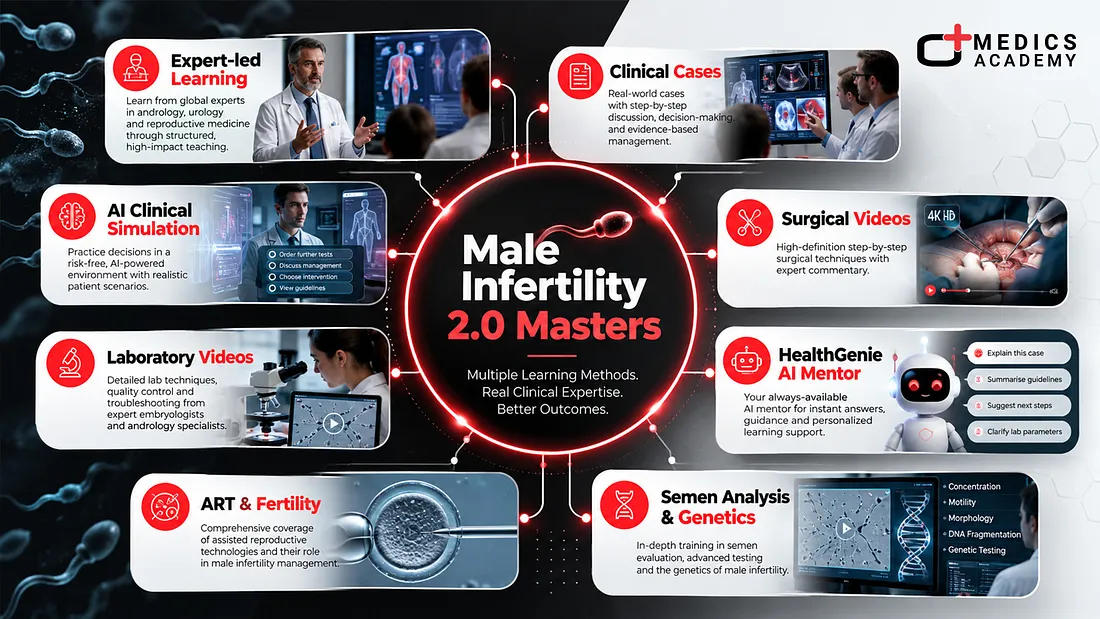
Male Infertility 2.0 Masters is an advanced medical education programme covering male infertility, andrology, reproductive medicine and sexual health.

The updated programme brings together:
- Male reproductive anatomy and physiology
- HPG-axis and reproductive endocrinology
- Semen analysis and advanced sperm testing
- Genetics and genetic evaluation
- Clinical assessment and diagnostic workflows
- Non-azoospermic male infertility
- Azoospermia evaluation and management
- Surgical sperm retrieval, including micro-TESE
- Varicocele and infertility
- Fertility preservation
- IUI, IVF and ICSI
- Surgical and laboratory video learning
- Male and female sexual dysfunction
- Clinical case discussions
- AI-powered clinical simulations
- HealthGenie — Intelligent AI Mentor for Medics
The programme is offered through Medics Academy, with the course designed to bring academic learning, practical exposure and technology-supported learning into a single educational experience.
But what makes the 2.0 approach different?
The emphasis is not simply on adding more content.
It is on creating more opportunities to apply, question and connect what is being learned.
What Has Changed in Male Infertility 2.0?
The most visible change is the integration of AI-enhanced clinical simulation into the learning experience.
Instead of limiting learning to recorded lectures and reading material, learners can work through clinically relevant scenarios and consider how they would approach a problem.

For example:
A patient presents with severe oligozoospermia.
What information would you want before deciding on the next investigation?
When would hormonal evaluation become relevant?
When might genetic testing need to be considered?
Could the patient’s history or examination change the diagnostic pathway?
If assisted reproduction becomes relevant, what factors would influence the management discussion?
These questions are closer to the way clinical reasoning happens in practice.
The simulation does not attempt to replace a specialist, a guideline or supervised clinical experience. Its role is educational: to provide another environment in which learners can practise structured thinking around clinical scenarios.
That distinction matters.
AI-supported medical education is developing quickly, and recent reviews have found potential benefits in areas including clinical reasoning, decision-making, problem-solving and other learning outcomes. At the same time, the evidence is heterogeneous, and researchers continue to emphasize structured implementation, appropriate instructional design and continued independent reasoning.
In other words, the value of AI is not simply that it is AI.
The value comes from how it is used for learning.
From Passive Learning to Active Clinical Thinking
This is perhaps the most important shift.
A learner may know the definition of azoospermia.
But clinical learning becomes more meaningful when that knowledge is placed inside a case.
A learner may know what a karyotype is.
The next question is when genetic evaluation becomes clinically relevant.
A learner may understand semen parameters.
The next challenge is interpreting them alongside the patient’s history and other findings.
A learner may know what micro-TESE means.
The deeper learning comes from understanding where sperm retrieval fits within the broader management pathway.
This is the difference between knowing a topic and working through a problem.
AI simulation can provide an additional environment for that second kind of learning.
A Curriculum Built Around the Clinical Journey
Male Infertility 2.0 Masters also brings together different parts of male reproductive medicine rather than treating them as isolated subjects.
The programme begins with the foundations:
- Anatomy of the male reproductive tract
- Development of the reproductive system
- Spermatogenesis and spermiogenesis
- Sperm transport and maturation
- HPG-axis physiology
- Seminal plasma
- Hypothalamic and pituitary disorders
It then moves into investigation and diagnosis, including:
- Clinical history and examination
- Hormonal evaluation
- Semen analysis
- Advanced semen analysis
- Genetic evaluation
- Karyotyping
- Y-chromosome evaluation
- CFTR testing
- Radiological assessment
From there, learners move into more complex areas such as non-azoospermic infertility, azoospermia, sperm retrieval, fertility preservation and ART.
That progression reflects an important principle in postgraduate learning:
Start with the biology. Understand the investigation. Then work through the clinical decision-making.
Azoospermia: Where Clinical Reasoning Becomes Particularly Important
Azoospermia provides a useful example of why an integrated learning approach matters.
Current EAU guidance recommends confirming non-obstructive azoospermia with consecutive semen analyses and using a comprehensive assessment that can include medical history, hormonal evaluation, genetic testing and scrotal ultrasound. For selected men with non-obstructive azoospermia who are candidates for ART, the guideline identifies microdissection TESE as the preferred sperm-retrieval approach.
These are not concepts that should be reduced to isolated facts.
A clinician needs to understand how the different pieces fit together.
That is why case discussions and simulation can complement conventional teaching.
The learner is encouraged to ask:

What do I know?
What do I still need to know?
Which finding changes the next step?
That is clinical reasoning.
Practical Exposure Beyond the Lecture
Another part of the Male Infertility 2.0 approach is the use of surgical and laboratory videos.

The course includes learning around areas such as:
- Varicocele and infertility
- Sperm retrieval techniques
- Semen analysis
- IUI
- Vitrification and cryofreezing
- IVF
- ICSI
- IMSI
- PICSI
- Sperm enhancement technologies
For a learner, visual exposure can help connect concepts that are difficult to fully appreciate through text alone.
Seeing a laboratory workflow or surgical procedure can make anatomy, terminology, sequencing and equipment more concrete.
It is still important to draw a line between educational exposure and hands-on clinical competency.
A video cannot replace supervised procedural training.
What it can do is provide another layer of preparation, visualization and conceptual understanding.
HealthGenie: Adding an AI Mentor to the Learning Experience
Male Infertility 2.0 Masters also includes HealthGenie — Intelligent AI Mentor for Medics.
The concept is different from simply watching another lecture.
A learner can use an AI-supported learning environment to revisit concepts, explore questions, work through scenarios and test their understanding.
For example, after learning about azoospermia, a learner may want to explore how different clinical findings influence the evaluation.
After studying semen analysis, they may want to revisit the interpretation of abnormal findings.
After learning about ART, they may want to understand how different treatment approaches fit into a broader fertility-management pathway.
Used appropriately, an AI mentor can become an additional layer between the lecture and revision.
It should not, however, become a substitute for guidelines, faculty expertise or independent clinical judgement.
That is particularly important in medicine, where an educational answer and a patient-specific clinical decision are not the same thing.
Why Male and Female Sexual Health Are Both Included
Male infertility does not always exist in isolation from sexual health.
Infertility can coexist with erectile or ejaculatory dysfunction, sexual distress, relationship difficulties and sexual problems affecting either partner.
For that reason, the programme also includes learning around female sexual dysfunction, covering areas such as sexual history and classification, hypoactive sexual desire disorder, vaginismus, dyspareunia, post-menopausal sexual health and medical management.
The broader goal is to help learners see reproductive and sexual health as connected areas of clinical care rather than completely separate subjects.
Who Is the Course Designed For?
Male Infertility 2.0 Masters is designed for medical graduates, postgraduate learners and healthcare professionals working in or developing expertise across areas such as:
- Urology
- Andrology
- Reproductive medicine
- Gynecology
- General surgery
- Embryology
- Andrology and embryology laboratories
- Clinical laboratory sciences
- Psychiatry and sexual medicine
The multidisciplinary nature of male infertility makes this breadth relevant.
A urologist may approach the patient from a different perspective than an embryologist. A reproductive medicine specialist may focus on a different part of the fertility pathway. A laboratory professional may see the case through the lens of sperm quality and laboratory processing.
A comprehensive learning environment can help connect those perspectives.
What Does “AI-Enhanced” Actually Mean in Medical Education?
The phrase “AI-powered” is becoming common in online education.
But adding AI to a course does not automatically make the learning experience better.
The more useful question is:
What is the learner able to do because AI has been added?
In Male Infertility 2.0 Masters, the focus is on using AI as part of a broader learning experience — through clinical simulation and an AI mentor — while retaining expert-led teaching, case discussions, practical videos and structured medical content.

That balance is important.
AI can help create opportunities for interaction and exploration, but medical education still depends on evidence, context, expert interpretation and the learner’s own reasoning.
The goal should therefore not be AI replacing medical education.
It should be AI supporting better ways of engaging with medical education.
From Learning More to Learning Differently
That may ultimately be the real idea behind Male Infertility 2.0.
The course is not simply a larger collection of lectures.
It brings together different ways of learning:
Learn the science.
Understand the investigations.
Work through clinical cases.
See procedures and laboratory workflows.
Explore scenarios through AI simulation.
Use an AI mentor to revisit and question what you have learned.
For healthcare professionals developing expertise in male infertility and reproductive medicine, this creates a learning journey that moves beyond simply completing modules.
Because in clinical practice, knowing the answer is only part of the challenge.
The harder question is often:
“What should I consider next, and why?”
That is where clinical reasoning begins.
And that is the direction in which technology-supported medical education can become genuinely useful — not by replacing clinical expertise, but by creating more opportunities to practise thinking, questioning and applying knowledge.
Explore Male Infertility 2.0 Masters
If you are looking for structured postgraduate learning in male infertility, andrology, reproductive medicine, semen analysis, azoospermia, sperm retrieval, ART and sexual medicine, you can explore Male Infertility 2.0 Masters and other medical education programmes through Medics Academy.
The future of medical education may not be about choosing between expert teaching and technology.
It may be about using both thoughtfully.
Male Infertility 2.0 Masters is an educational programme designed to support deeper knowledge and practical understanding across male infertility, andrology, reproductive medicine and sexual health. Educational simulations and AI-supported learning should not be considered substitutes for patient-specific clinical assessment, current clinical guidelines, specialist supervision or professional judgement.




Comments (0)
No comments yet. Be the first to share your thoughts!