
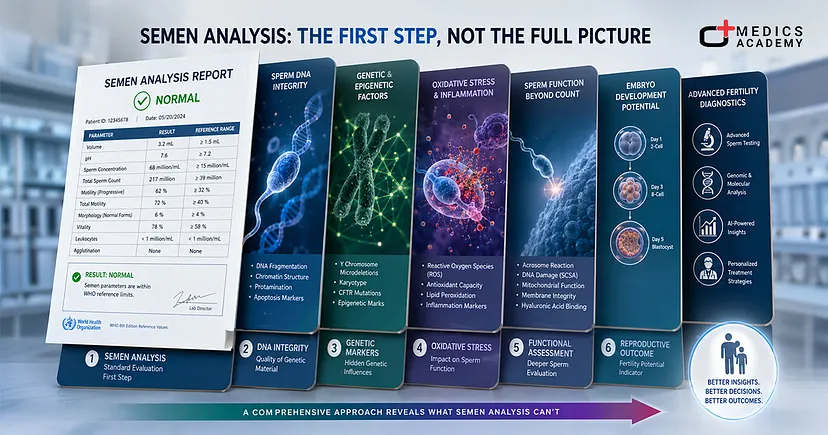
A Normal Semen Analysis Is Reassuring — But It Is Not the Whole Story
A couple presents after nearly two years of unsuccessful attempts to conceive. The female partner has undergone a comprehensive evaluation. Ovulation is regular. Hormonal parameters are normal. Tubal patency has been confirmed.
The male partner’s semen analysis is also within reference ranges. At first glance, everything appears reassuring. Yet conception has not occurred.
For many clinicians, this remains one of the most challenging scenarios in reproductive medicine. It also highlights an important reality that is increasingly shaping modern fertility care:
A normal semen analysis is an important finding — but it is not a definitive assessment of male reproductive potential.
Male factors contribute to approximately 40–50% of infertility cases, either independently or in combination with female factors. Yet in many clinical settings, conventional semen analysis remains the primary tool used to assess male fertility potential.
As our understanding of male infertility evolves, clinicians are recognizing that fertility evaluation must extend beyond sperm count, motility, and morphology alone.
The Real Shift in Fertility Care Is Not More Testing — It Is Better Understanding
For decades, conventional semen analysis has served as the foundation of male fertility assessment.
It provides valuable information regarding:
- Sperm concentration
- Motility
- Morphology
- Semen volume
- Vitality
These parameters remain essential and should never be dismissed.
However, semen analysis primarily evaluates observable characteristics. It does not fully assess the biological processes that determine whether sperm can successfully fertilize an oocyte, contribute to embryo development, and support an ongoing pregnancy.
This distinction is increasingly important as fertility care moves toward precision medicine.
The question is no longer:
“Is the semen analysis normal?”
The more clinically relevant question is:
“Does this patient’s reproductive profile explain the couple’s fertility outcome?”
What Conventional Semen Analysis Can — and Cannot — Tell Us
Conventional Semen Analysis Can Assess
Conventional Semen Analysis Cannot Fully Assess
Sperm concentration
Sperm DNA integrity
Motility
Oxidative stress
Morphology
Genetic abnormalities
Vitality
Fertilization competence
Semen volume
Embryo development potential
Basic seminal parameters
Functional sperm performance
Understanding this distinction helps clinicians appreciate both the strengths and limitations of semen analysis.
A normal report should be viewed as an important starting point — not necessarily the end of the diagnostic journey.

Why “Normal” Does Not Always Mean Fertile
The reference values established by the World Health Organization are designed to identify significant abnormalities and provide population-based benchmarks. They are not guarantees of fertility.
Population-level reproductive trends also provide important context. While an individual semen analysis may fall within reference ranges, researchers continue to study broader changes in male reproductive health worldwide. A useful overview can be found in this analysis of the global decline in sperm count and sperm concentration over time.
Many men with semen parameters within reference ranges achieve pregnancy without difficulty. Others may experience prolonged infertility despite apparently normal results.
This observation has led researchers and clinicians to explore factors that may not be fully captured by conventional semen analysis, including:
- Sperm DNA integrity
- Oxidative stress
- Genetic abnormalities
- Inflammation
- Environmental exposures
- Functional sperm defects
Importantly, the presence of these factors does not automatically explain every case of infertility. However, in selected patients, they may provide clinically meaningful insights that influence management decisions.
The Rise of Advanced Male Fertility Testing
Over the past decade, andrology has expanded significantly beyond traditional semen analysis. A growing range of investigations can help identify hidden contributors to reproductive dysfunction when clinically indicated.
Sperm DNA Fragmentation Testing
DNA fragmentation has emerged as one of the most widely discussed areas in male fertility research.
Elevated sperm DNA damage has been associated with:
- Delayed conception
- Poor embryo development
- Recurrent implantation failure
- Recurrent pregnancy loss
Notably, some men with elevated DNA fragmentation may still demonstrate normal conventional semen parameters.
At the same time, clinicians should recognize that current guidelines generally support selective rather than universal use of DNA fragmentation testing. Its value lies in appropriate patient selection and interpretation within the broader clinical context.

Oxidative Stress Assessment
Oxidative stress is increasingly recognized as a major contributor to sperm dysfunction.
Potential contributors include:
- Obesity
- Smoking
- Varicocele
- Genitourinary infection
- Environmental toxin exposure
- Metabolic disease
Understanding oxidative stress may help guide targeted interventions aimed at improving reproductive health.
Genetic Evaluation
Genetic testing has become an essential component of male infertility assessment in selected populations.
Investigations may include:
- Karyotyping
- Y-chromosome microdeletion analysis
- CFTR mutation testing
These evaluations can significantly influence counselling, treatment planning, and reproductive decision-making.
Functional and Emerging Assessments
A number of emerging technologies are attempting to evaluate sperm function beyond conventional microscopy.
While some remain investigational or variably adopted across regions, they reflect a broader movement toward deeper biological characterization of male reproductive health.
Not Every Patient Needs Every Test
One of the most important lessons in modern fertility practice is that more testing does not automatically translate into better care.
The goal is not to order every available investigation.
The goal is to identify the right investigation for the right patient at the right time.
Clinicians increasingly face the challenge of balancing:
- Clinical utility
- Evidence strength
- Patient burden
- Cost-effectiveness
- Treatment impact
Advanced testing should therefore be individualized rather than applied indiscriminately.
This precision-based approach is becoming a defining characteristic of high-quality fertility care.
The Bigger Transformation: From Female-Centric to Couple-Centric Care
Historically, infertility evaluation often focused disproportionately on the female partner.
This shift reflects a broader recognition that male reproductive health remains underdiagnosed and frequently underrepresented in fertility care. For a deeper discussion on why clinicians need to rethink their approach to male infertility, read The Hidden Crisis of Male Infertility: Why Every Clinician Must Upgrade Their Knowledge in 2026.
Today, that paradigm is changing.
Male factors contribute to a substantial proportion of infertility cases, either independently or in combination with female factors.
As a result, leading fertility centres increasingly advocate simultaneous evaluation of both partners early in the diagnostic journey.
This shift represents more than a change in testing strategy.
It represents a fundamental change in how infertility itself is understood.
Infertility is not solely a female condition or a male condition.
It is a couple’s condition.
Lifestyle and Reproductive Health: The Often Overlooked Opportunity
While advanced diagnostics continue to evolve, some of the most meaningful interventions remain surprisingly simple.
Growing evidence suggests that reproductive outcomes may be influenced by factors such as:
- Weight management
- Physical activity
- Sleep quality
- Smoking cessation
- Alcohol moderation
- Metabolic health optimization
- Reduction of environmental toxin exposure
As reproductive medicine advances, prevention and optimization are becoming increasingly important alongside diagnosis and treatment.
The Future Is Precision, Not More Testing
One common misconception is that progress in male infertility simply means adding more investigations.
In reality, the future is unlikely to be defined by a single breakthrough test.
Instead, the next decade will be shaped by clinicians who can intelligently integrate clinical history, physical examination, laboratory findings, genetics, lifestyle factors, and reproductive outcomes into a unified decision-making framework.
The future belongs not to those who order the most tests — but to those who know which test matters, when it matters, and how it changes management.
What the Next Decade May Look Like
Male infertility is entering an era of rapid innovation.
Emerging developments include:
- AI-assisted semen analysis
- Molecular and genomic profiling
- Advanced sperm selection technologies
- Integrated reproductive analytics
- Precision medicine approaches
While many of these technologies continue to evolve, they point toward a future in which fertility evaluation becomes increasingly individualized and biologically informed.
The era of relying on a single test to define male fertility is gradually giving way to a more comprehensive understanding of reproductive health.
Three Practical Takeaways for Clinicians
Before considering advanced investigations, it is worth remembering three key principles:
1. A normal semen analysis is reassuring — but not definitive.
Conventional semen analysis remains essential, yet it does not capture every factor influencing fertility.
2. Advanced testing should be guided by clinical context.
The value of any investigation depends on whether the results can meaningfully influence management.
3. Evaluate the couple, not just the individual.
The most effective fertility care increasingly involves coordinated assessment of both partners from the outset.
The Training Gap in Modern Andrology
The science of male infertility is advancing faster than many training pathways.
Clinicians today are expected to understand far more than semen parameters alone.
Modern practice increasingly requires familiarity with:
- Hormonal evaluation
- Genetic testing
- Azoospermia management
- Surgical sperm retrieval
- ART decision-making
- Laboratory science
- Fertility preservation
- Evidence-based treatment strategies
Yet structured, practical training in these areas remains limited in many settings.
Recognizing this need, the Male Infertility Masters program was developed to provide comprehensive education in contemporary andrology and reproductive medicine.
The curriculum combines clinical decision-making, laboratory science, microsurgical techniques, and evidence-based management approaches to help clinicians navigate the rapidly changing landscape of male fertility care.
Final Thought
The future of male infertility evaluation is not about replacing semen analysis.
It is about understanding its strengths, recognizing its limitations, and integrating it into a broader framework of evidence-based, patient-centered care.
Because sometimes the most important finding is not what appears on the report.
It is what the report cannot tell us.
And recognizing that distinction may change the trajectory of care for the couple sitting across from us.
Further Reading
- WHO Laboratory Manual for the Examination and Processing of Human Semen (6th Edition)
- AUA/ASRM Guideline on Diagnosis and Treatment of Male Infertility
- EAU Guidelines on Sexual and Reproductive Health
- Recent literature on sperm DNA fragmentation, oxidative stress, and advanced male fertility assessment
How are you incorporating advanced male fertility evaluation into your practice? Share your experience, challenges, or perspective in the comments.






Comments (0)
No comments yet. Be the first to share your thoughts!