
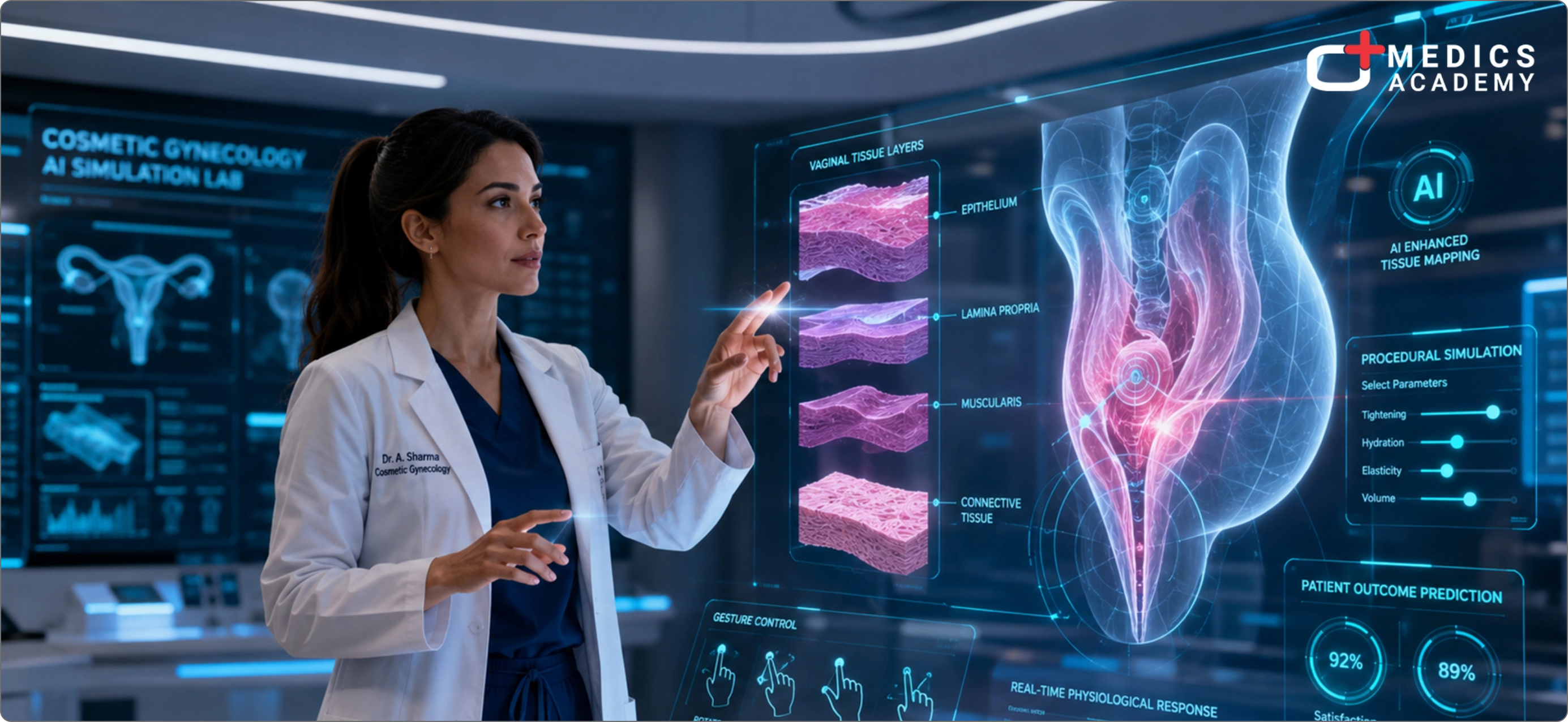
The biggest limitation in cosmetic gynaecology training may no longer be access to procedures.
It may be the inability to repeatedly visualise anatomy before independent clinical practice.
For decades, procedural medical education has followed a familiar model:
Attend workshops.
Observe experts.
Watch live demonstrations.
Practice briefly under supervision.
Then transition into real-world patient care.
That system worked reasonably well when procedural complexity was lower, technological evolution was slower, and specialities were less visually demanding.
But cosmetic gynaecology is no longer a simple workshop-based field.
Why More Gynaecologists Are Expanding Into Cosmetic Gynaecology in 2026? It is rapidly evolving into a sophisticated intersection of regenerative medicine, intimate wellness, pelvic floor rehabilitation, menopausal care, energy-based therapeutics, and minimally invasive aesthetic-functional procedures. Why Gynaecologists Are Adding Aesthetic Procedures to Increase Clinic Revenue, and as the speciality becomes more anatomy-intensive and technologically complex, a deeper educational challenge is beginning to emerge:
Observation alone is often no longer enough to create procedural confidence.
The Confidence Gap: Most Procedural Training Still Struggles to Solve
A clinician attends an advanced laser vaginal rejuvenation workshop.
Inside the training environment, everything appears clear.
The procedural flow makes sense.
The device settings are explained carefully.
The anatomy seems understandable while the expert performs the treatment.
But several weeks later, while preparing to independently perform a similar procedure in real clinical practice, uncertainty begins to surface.

Not necessarily because the clinician lacks intelligence.
Not because the procedure itself is impossible to understand.
But because human procedural memory behaves very differently from theoretical memory.
In anatomy-sensitive specialities, clinicians often need repeated visual exposure before procedural workflows become mentally stable.
And this is where many traditional training models quietly struggle.
A single workshop may provide procedural exposure.
But it may not provide enough anatomical repetition for long-term visual confidence.
That distinction matters far more than most medical education systems currently acknowledge.
Cosmetic Gynaecology Is Uniquely Dependent on Visual-Spatial Learning
Cosmetic gynaecology is not merely protocol-based medicine.
It is highly visual medicine.

Clinicians are constantly interpreting tissue depth, anatomical variation, device positioning, injection planes, energy distribution, and procedural sequencing in real time.
Small anatomical misunderstandings can significantly influence:
- Procedural precision
- Treatment confidence
- Tissue response
- Complication risk
- Aesthetic outcomes
Unlike purely theoretical disciplines, procedural mastery in cosmetic gynaecology depends heavily on visual-spatial familiarity.
A clinician may intellectually understand fractional CO2 therapy, PRP-assisted regenerative procedures, RF-based tightening systems, or G-spot augmentation techniques.
But understanding a procedure conceptually is very different from mentally reconstructing dynamic anatomy during a live patient encounter.
That reconstruction ability is where many clinicians experience hesitation.
And hesitation in procedural medicine often originates from incomplete visual familiarity rather than a lack of theoretical knowledge.
Why Traditional Workshops Have Structural Educational Limitations
Workshops remain valuable.
They provide mentorship, exposure, networking, and supervised clinical observation.
But workshops also face unavoidable educational constraints:
- limited procedural repetition
- Restricted viewing angles
- Variable patient anatomy
- Time-constrained teaching
- Incomplete visualization of tissue interaction
- Cognitive overload during live demonstrations
In many cases, clinicians leave understanding what happened during the procedure , while still lacking deep familiarity with how the anatomy dynamically behaved throughout the treatment process.
That difference becomes increasingly important as cosmetic gynaecology procedures grow more technically sophisticated.
Modern procedural medicine is placing greater cognitive demand on clinicians than many traditional educational systems were originally designed to support. This shift is not happening only in cosmetic gynaecology.
Why Simulation-Based Learning Is Becoming Increasingly Important Across Medicine
This shift is not happening only in cosmetic gynaecology.
Across surgery, interventional medicine, aviation medicine, robotic procedures, emergency care, and minimally invasive specialities, simulation-based learning models are expanding rapidly.
The reason is rooted in cognitive science.
The human brain develops procedural confidence through repeated experiential visualisation.
Not simply through passive observation.
Multiple studies in simulation-supported medical education have demonstrated improvements in:
- Procedural retention
- Learner confidence
- Technical familiarity
- Workflow recall
- Educational engagement
Because repetition changes how procedural memory forms.
A clinician who repeatedly visualises anatomy and procedural sequencing develops stronger mental mapping long before independent execution begins.
That mapping process is psychologically critical.
Especially in specialities where anatomical precision directly influences outcomes.
Why Cosmetic Gynaecology May Become One of the Most Simulation-Driven Specialities
Few specialities are as dependent on delicate anatomical interpretation as cosmetic gynaecology.
Procedures often involve:
- Layered tissue interaction
- Energy-based systems
- Regenerative biologics
- Injection precision
- Mucosal anatomy
- Vascular awareness
- Dynamic treatment planning
This makes the speciality particularly well-suited for immersive anatomical simulation learning.
Instead of relying solely on one-time workshop exposure, clinicians can repeatedly experience structured procedural visualisation environments that simulate:
- Anatomical orientation
- Tissue-layer understanding
- Procedural transitions
- Device positioning
- Injection sequencing
- Energy-delivery workflows
- Clinician's hand movement
- Treatment progression dynamics
That repeated exposure fundamentally changes the learning experience.
Because procedural confidence is frequently built visually before it is built technically.
Clinicians often need to repeatedly “see” anatomy mentally before they can comfortably execute procedures physically.
Why AI-Enhanced Simulation Learning Could Redefine Procedural Education

Artificial intelligence is now accelerating this transformation further.
Traditional educational videos typically document procedures.
AI-enhanced simulation learning systems can go much deeper.
They can create immersive educational environments designed specifically around:
- Procedural cognition
- Anatomical repetition
- Stepwise visualization
- Learning retention
- Visual reinforcement
- Adaptive educational sequencing
This is an important distinction.
The future of procedural education may not simply involve watching more videos.
It may involve building highly structured visual learning ecosystems that train the brain to process anatomy more effectively before live clinical execution.
That shift could become transformational for procedural medicine over the next decade.
Because the educational bottleneck may no longer be access to information.
It may be the quality of anatomical visualisation before independent practice begins.
Why We Introduced AI-Enhanced Simulation Learning Into Our Master’s Program
As cosmetic gynaecology continued evolving, we observed a recurring challenge across procedural training environments:
Technical exposure was not always translating into procedural confidence.
Clinicians frequently understood procedures conceptually while still feeling uncertain about independently reconstructing anatomical workflows later in practice.
That realisation led us to integrate AI-enhanced anatomical and procedural simulation learning modules into our Cosmetic Gynaecology & Sexology Master’s Program.
The goal was never simply to make learning feel more “advanced.”
It was to make procedural education more repeatable, immersive, and cognitively effective.
Through structured simulation-supported learning environments, clinicians can repeatedly study:
- Anatomy
- Procedural sequencing
- Tissue interaction
- Device handling
- Treatment progression
- Workflow transitions
- Procedural visualisation dynamics
before independently performing similar procedures clinically.
Importantly, simulation learning is not intended to replace supervised clinical mentorship.
But it may significantly reduce the confidence gap that often exists between workshop observation and real-world procedural execution.
And in anatomy-sensitive specialities, that difference may become increasingly important.
The Future Cosmetic Gynaecology Specialist May Train Very Differently

Over the next decade, cosmetic gynaecology education may undergo a fundamental shift.
The most effective clinicians may not simply be those who attended the greatest number of workshops.
They may be those who developed the strongest visual-anatomical familiarity before ever performing procedures independently.
Future training systems may increasingly combine:
- Simulation-based anatomy learning
- AI-enhanced procedural visualization
- Immersive workflow repetition
- Digital procedural ecosystems
- Cognitive reinforcement models
- Structured visual retention systems
Because modern procedural medicine has become too visually complex for passive learning alone.
And cosmetic gynaecology may become one of the first specialties where this educational transformation becomes impossible to ignore.
The future of the field may not be defined only by better devices or newer regenerative therapies.
It may be defined by how effectively clinicians learn to visualize anatomy long before entering the treatment room.






Comments (0)
No comments yet. Be the first to share your thoughts!