
Most people are comfortable talking to a doctor about a headache, fever or back pain. Sexual health can be different. Many people still hesitate to talk about desire, intimacy, erectile dysfunction, painful sex, infertility or other sexual concerns — even when those concerns are affecting their health and quality of life.
That is one reason World Sexual Health Day, observed every year on September 4, matters.
It creates space for conversations that are often left unspoken and reminds us that sexual health is not separate from healthcare. It is connected to physical wellbeing, mental health, relationships, reproductive health, dignity, autonomy and quality of life.
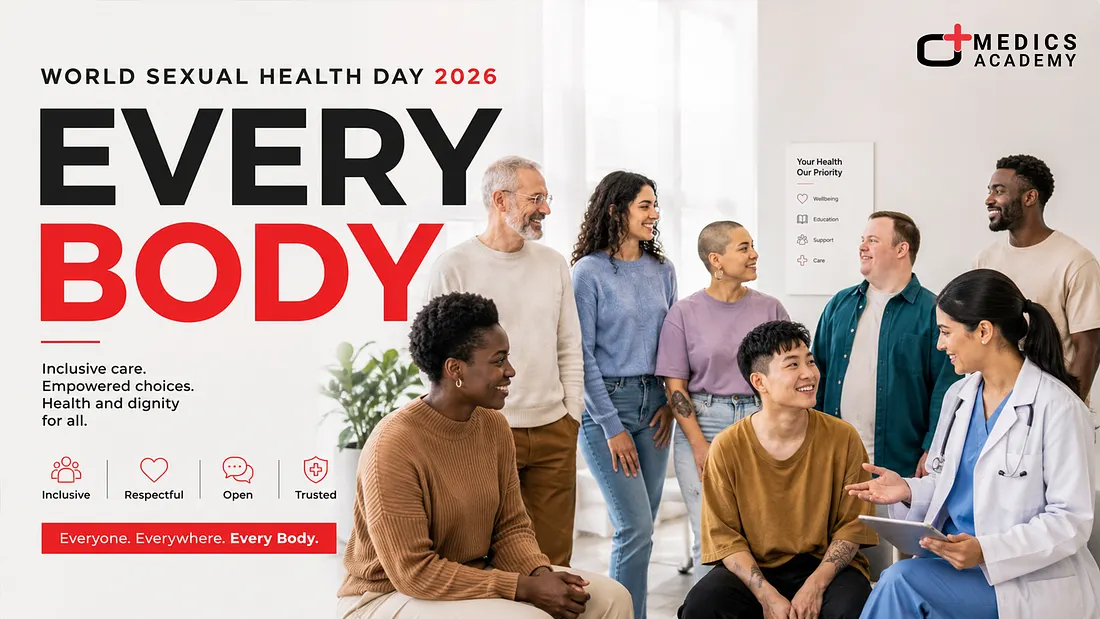
The World Sexual Health Day 2026 theme is “Every Body.” The theme from the World Association for Sexual Health (WAS) emphasizes that sexual health, rights, justice and pleasure belong to every person and every body.
For healthcare professionals, there is an important question behind that message:
Are we prepared to care for every body when it comes to sexual health?
What Is World Sexual Health Day?
World Sexual Health Day is an annual global initiative of the World Association for Sexual Health (WAS), held on September 4.
It was first launched in 2010 to encourage greater awareness, education and dialogue around sexual health and sexual rights. WAS continues to use the day to promote sexual health, rights, justice and pleasure for all, while encouraging education, discussion and action.
The 2026 theme, “Every Body,” takes a broad view of sexual health.
It recognizes that sexuality is experienced through the body, but the experience of sexual health is shaped by much more than biology. Relationships, education, healthcare services, social circumstances, culture, technology and laws can all influence how people understand and experience their sexuality.
That makes the theme particularly relevant to modern healthcare.
Sexual Health Is Part of Overall Health
Sexual health is sometimes reduced to preventing sexually transmitted infections or addressing reproductive problems.
Those are important, but they are only part of the picture.

Sexual health can also involve:
- Sexual wellbeing and satisfaction
- Sexual function and dysfunction
- Intimacy and relationships
- Consent and bodily autonomy
- Reproductive health
- Fertility
- Menopause and ageing
- Psychological and emotional wellbeing
- Gender and sexuality
- Prevention and management of sexually transmitted infections
Sexual concerns can also appear alongside other health conditions.
For example, erectile dysfunction may have physical, hormonal, metabolic or psychological contributors. Pain during sex may be associated with gynaecological, hormonal, pelvic or psychological factors. Changes in sexual desire may involve medication, stress, relationship concerns, mental health or other underlying conditions.
A single symptom does not always tell the whole story.
This is where sexual medicine becomes valuable.
Why Sexual Medicine Needs a Multidisciplinary Approach
Sexual medicine brings together knowledge from several areas of healthcare.
Depending on the patient’s concern, assessment and management may involve perspectives from urology, gynaecology, psychiatry, psychology, endocrinology, reproductive medicine, dermatology and other specialties.
The aim is not simply to identify a sexual problem.
It is to understand why it is happening, how it is affecting the individual, and what kind of care may be appropriate.
Common concerns encountered in sexual medicine include erectile dysfunction, premature ejaculation, female sexual dysfunction, low sexual desire, vaginismus, dyspareunia, Peyronie’s disease, infertility-related sexual difficulties, menopause-related concerns and sexually transmitted infections.
For clinicians, this requires more than theoretical knowledge.
It requires the ability to take an appropriate history, communicate sensitively, assess possible causes and, when necessary, work as part of a multidisciplinary team.

The Mind Matters Too: Psychosexual Health
Sexuality does not exist separately from emotional and psychological wellbeing.
Anxiety, stress, relationship difficulties, past experiences, body image, cultural expectations and psychological conditions can all influence sexual wellbeing and sexual function.

That is why psychosexual medicine has an important role in sexual healthcare.
Medics Academy’s Psychosexual Medicine Masters explores the psychological, psychosomatic and relationship dimensions of sexual health. Its curriculum includes psychosexual development, human sexual response, bio-psycho-social aspects of sexuality, sexual myths and misconceptions, psychological perspectives on sexual dysfunction, counselling, behavioural approaches, couple sex therapy, sexual violence, pornography and sexuality, gender and sexuality, and clinical case scenarios.
The Psychosexual Techniques Masters goes further into practical approaches, including the psychosomatic circle of sex, psychological causes of sexual dysfunction, intrapsychic and cultural factors, relationship-related causes and counselling approaches.
For healthcare professionals, understanding this dimension can change the way a sexual-health consultation begins.
Sometimes the most important step is simply knowing what to ask and how to ask it.
Women’s Sexual Health: Beyond Reproduction
Women’s sexual health deserves attention throughout the life course — not only during the reproductive years.
Pregnancy, childbirth, hormonal changes, menopause, chronic illness, fertility concerns and other health experiences can influence sexual wellbeing. Pain, changes in desire and other sexual difficulties can also affect relationships and quality of life.
Medics Academy’s Women’s Reproductive & Sexual Health Masters focuses on the connection between reproductive and sexual wellbeing and provides a dedicated learning pathway for professionals interested in women’s health.
This broader perspective is important because reproductive health and sexual health may overlap, but they are not the same thing.
A woman’s sexual wellbeing matters before, during and after the reproductive years.
Men’s Sexual Health Deserves the Same Attention
Men’s sexual health is another essential part of the conversation.
Erectile dysfunction, premature ejaculation, male infertility, hormonal concerns and other sexual difficulties can affect physical health, confidence, relationships and quality of life. In some cases, a sexual-health concern may also prompt investigation of an underlying medical condition.
Medics Academy’s Andrology & Sexual Medicine programmes address areas including male infertility, sexual dysfunction, erectile dysfunction, reproductive health and andrology.
Its IMA-AMS Fellowship in Andrology & Sexual Medicine combines clinical learning with hands-on observational training and covers areas such as male infertility, erectile dysfunction and male ageing, alongside multidisciplinary perspectives involving surgery, imaging, pathology, endocrinology, radiology and basic sciences.
The larger point is simple:
Men’s sexual health is healthcare — and it deserves to be discussed as such.
“Every Body” Also Means Every Stage of Life
Sexuality changes over time.

Adolescence brings questions about development and sexual health. Relationships can influence intimacy and wellbeing. Pregnancy and childbirth can change sexual function. Illness and medical treatment can affect desire and sexual response. Menopause and ageing can bring new physical and emotional changes.
Healthcare needs to adapt accordingly.
This is reflected in Medics Academy’s broader sexual-health education portfolio, which includes learning around sexual medicine, psychosexual medicine, women’s reproductive and sexual health, andrology and sexual medicine, gender and sexuality, and related areas. The catalogue includes Masters, Fellowship, Post Graduate and focused proficiency programmes.
The Gender & Sexuality course, for example, covers sexual development, sexual response, hormones, puberty, gender-related terminology, hormone therapy and LGBTQIA+ topics.
This reflects an important principle behind the “Every Body” theme:
Good sexual healthcare begins by recognizing that patients are not all the same.
From World Sexual Health Day Awareness to Professional Education
World Sexual Health Day can start a conversation.
But conversations need informed professionals behind them.
A patient may not arrive saying, “I have female sexual dysfunction” or “I need psychosexual therapy.”
They may simply say:
“Sex has become painful.”
“I don’t feel interested anymore.”
“I’m worried something is wrong.”
“I can’t maintain an erection.”
“We’re trying to conceive, and this is affecting our relationship.”
These statements can point to very different clinical situations.
Healthcare professionals therefore need the knowledge to listen carefully, ask appropriate questions, understand potential causes and decide when further assessment, treatment or referral may be needed.
That is where sexual health education for healthcare professionals becomes important.

Building Expertise in Sexual Health
For clinicians who want to develop or expand their knowledge, Medics Academy offers several pathways across sexual and reproductive healthcare.
Sexual Medicine
The Sexual Medicine Masters provides a broad multidisciplinary foundation, covering sexual and reproductive healthcare, sexual dysfunction, infertility, men’s sexual health, women’s sexual health, sexually transmitted infections, psychosexual counselling and reproductive health.
The Sexual Medicine Fellowship offers another pathway for professionals seeking focused education in the evaluation and management of sexual-health concerns.
Psychosexual Medicine
For professionals interested in the psychological, behavioural and relationship dimensions of sexuality, the Psychosexual Medicine and Psychosexual Techniques programmes provide focused learning in psychosexual assessment, counselling and therapeutic approaches.
Women’s Reproductive & Sexual Health
The Women’s Reproductive & Sexual Health Masters provides specialised learning connecting reproductive health with women’s sexual wellbeing.
Andrology & Sexual Medicine
For professionals interested in male reproductive and sexual health, Medics Academy’s PG in Andrology & Sexual Medicine brings together uro-andrology, male and female sexual dysfunction, psychosexual therapy and andrology laboratory-related learning.
The portfolio also includes programmes such as Cosmetic Gynecology & Sexology 2.0, Gender & Sexuality, Male Infertility, and other specialised sexual and reproductive health courses.
What Should World Sexual Health Day Change?
Perhaps the most useful question this World Sexual Health Day is not simply:
“How do we celebrate sexual health?”
It is:
“How can we make sexual health easier to discuss and better to manage?”
That change can begin in the consultation room.
It can begin when a doctor feels comfortable asking about sexual wellbeing.
It can begin when a patient realizes that sexual pain, erectile dysfunction, low desire or intimacy concerns are legitimate reasons to seek professional help.
It can begin when healthcare education gives clinicians the knowledge and communication skills to approach these conversations with confidence and without judgment.
That is the spirit of “Every Body.”
Not one type of body.
Not one age group.
Not one gender.
Not one sexual-health concern.
Every body deserves to be heard, respected and supported.
This World Sexual Health Day, Make Sexual Health Part of Healthcare
September 4 is a reminder that sexual health belongs in the wider conversation about health and wellbeing.
For patients, that can mean having the confidence to speak.
For healthcare professionals, it can mean being prepared to listen.
And for medical education, it means creating opportunities to develop the knowledge needed for thoughtful, evidence-informed sexual healthcare.
This World Sexual Health Day, let’s move beyond simply talking about sexual health.
Let’s build better sexual healthcare — one informed conversation at a time.
If you’re a doctor or healthcare professional looking to strengthen your knowledge in sexual medicine, psychosexual medicine, women’s sexual health, men’s sexual health, andrology or related fields, explore the programmes available through Medics Academy.
Explore Medics Academy Courses
Every body matters. Better sexual healthcare starts with understanding every body.






Comments (0)
No comments yet. Be the first to share your thoughts!